Third Places That Transform Us
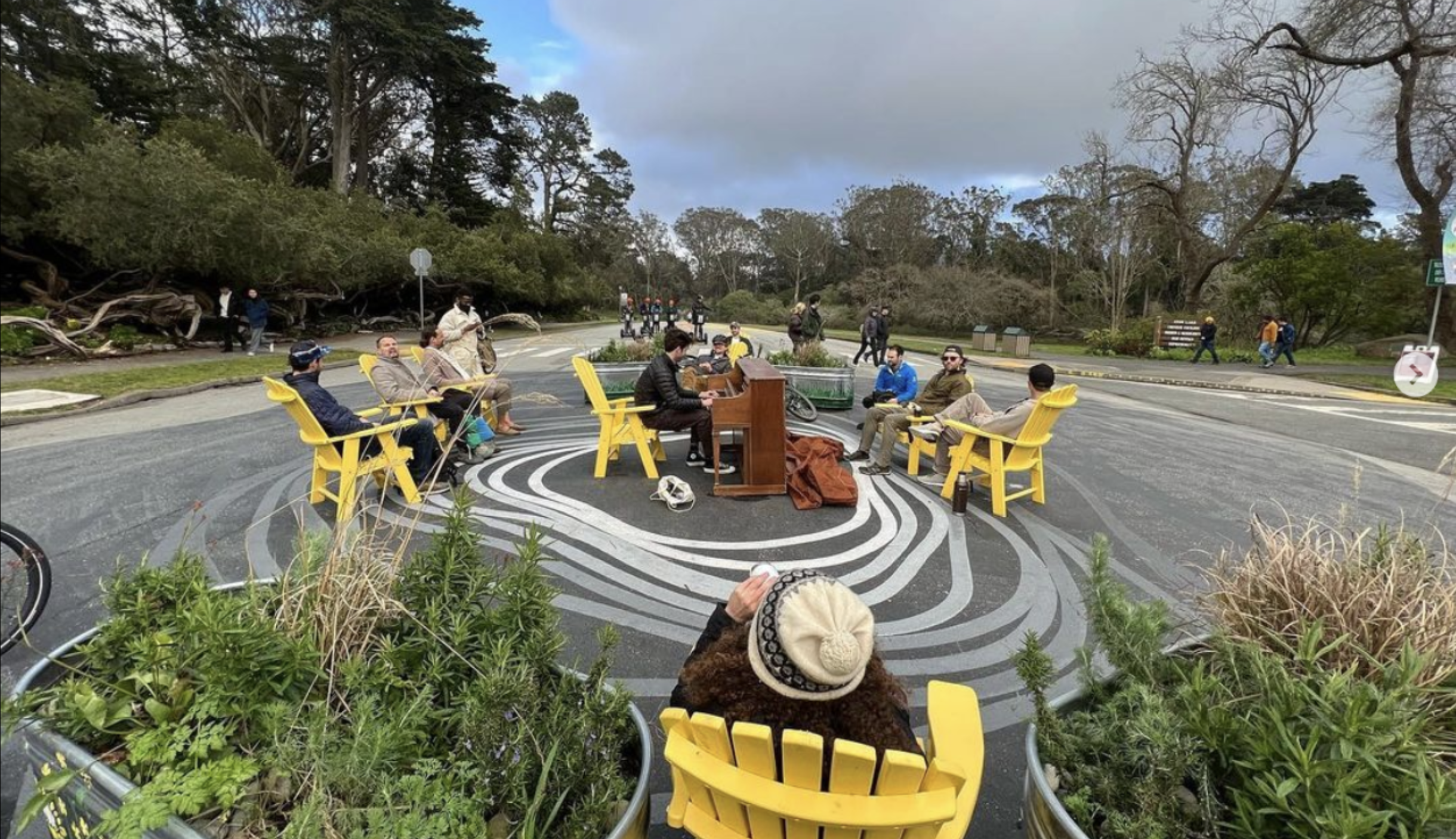
The Golden Mile, Golden Gate Park, San Francisco. Photo courtesy of Illuminate, the public arts non-profit leading the Golden Mile partnership.
Building Public Space for Human Connection
When I was a kid in 1970s Tucson, there was one man who jogged through our neighborhood every day. I can still picture him out there alone in the hot sun. We all knew him the same way: through a windshield, driving past. Our ranch houses sat back from the street behind prickly desert landscaping, no sidewalks, no front porches, and we came and went by car. We barely knew our neighbors' names. The jogger stood out because he was usually the only human out in public.
I craved something I'd only seen in books and on TV. Town squares with outdoor cafes. Main streets where the shopkeepers knew you. Lemonade on a porch while neighbors passed by. I didn't have a word for it then, but what I wanted were third places where people come into contact with each other.
So in fifth grade I created one. I rounded up my girlfriends and we marched door to door singing “Deck the Halls” in the December desert: me, the one Jewish kid in the group. When we spotted a mezuzah (a ritual object on the door indicating a Jewish household) we switched to a Hanukkah song. The surprise on people's faces when they opened their doors never got old. I didn't have a gathering place, so I turned the neighborhood itself into one for a night of holiday caroling.
The Spaces In Between
Third places are the informal spaces outside of home and work where people gather naturally. Cafes, libraries, faith houses, barbershops, main streets, neighborhood parks. The sociologist Ray Oldenburg named them in 1989 and made the case that they provide the rich soil for community and social connection to take root and grow. Third places are where you encounter people you didn't plan to see. Where conversation happens across lines of age, background and politics. Where you become a familiar face and feel seen and known.
Many of those places were already fading before the pandemic. Independent businesses gave way to chains. Congregations shrank. Public budgets tightened around libraries and parks. Then our routines around gathering were disrupted even further, and we lost our habits for informal gathering along with them. A habit of stopping by is easy to break and slow to rebuild.
With fewer spaces to run into one another in ordinary, unplanned ways, everyday connections become less frequent, and over time isolation grows. Public trust feels more fragile. That steady sense of being rooted in a community disappears.
The Room Is Not Enough
Here's where I think we go wrong. We talk about third places as though the space alone is the thing; “Save the library, open the cafe, and community will follow.”
Walk into most coffee shops today and you'll see what actually happens. People sit alone at separate tables with headphones on and laptops open, doing work they could have done at home. The space is full and nobody is meeting anybody.
I've written before about the parents on the benches at my kids' swim lessons, all of us sharing 45 minutes a week for months and leaving without learning each other's names. Heads down, scrolling, catching up on email. The space was there. The regularity was there. What was missing was any reason to turn toward each other.
A third place does its real work when someone inside it is paying attention. The barista who learns your name and introduces you to other regulars. The librarian who starts a repair club. The bar owner who puts in one long table instead of eight small ones. The cafe with public notice boards for information sharing and connecting. Those are design choices, and somebody made them on purpose.
Where People Are Finding Each Other Now
What gives me hope is that people are still building these spaces, and some of them are building better ones.
Street markets bring neighbors onto the same few blocks on the same morning every week. Repair fairs invite people to show up with their skills and fix each other's lamps and bicycles and torn coats, which turns out to be a wonderful excuse to talk to a stranger for twenty minutes. Developers are designing housing with shared courtyards, community rooms and kitchens, betting that proximity plus a reason to linger will produce neighbors. Run clubs have taken off in cities across the country, and for a lot of young adults they've become a key way they meet people.
I wrote last year about two businesses in south Minneapolis that became hubs of mutual aid during the recent ICE invasion there. One was a coffee shop. One was a gallery. When the moment came, they were already the places people congregated.
In San Francisco, a 1.5 mile stretch of road in Golden Gate Park was closed to cars and transformed into an interactive public art space with massive murals, large-scale sculptures, 150 Adirondack chairs, an outdoor living room, family games, open-play pianos, a coffee caravan, a children's storyboard walk, live music and a beer garden. What had been one of San Francisco’s most dangerous roads for pedestrians and bikers is now an urban oasis, a huge third place filled with people of all ages experiencing wonder, joy and connection.
Repeated Presence, Invitation, Care
Belonging is built through repeated presence, invitation and care. That's true of a workplace, and it's true of a farmers market, neighborhood park, or even the sidewalk in front of your home.
Repeated presence means the same people showing up in the same place often enough to become familiar. This is why the weekly market builds deeper community than an annual festival, and why a standing Tuesday night gathering beats a one-time event with better catering. Familiarity is mostly a function of frequency.
Invitation means someone has to open the door. Most people will not insert themselves into a group of strangers, no matter how welcome they would actually be. A host, a shared table, a name learned, a first question: these are small things that bring people out of their shells.
Care means the place has to hold people once they arrive. Who feels comfortable here, and who doesn't? Who gets included, and who gets overlooked? Who can afford to linger for two hours, and who can't? Space designers who ask these questions will find ways to expand access to more people.
An Invitation
You probably have a third place you frequent, or perhaps you once had one. You might be sitting in one right now. Look at it the way I looked at that swim school, with a designer's eye for a minute. What brings people back? What would it take for two regulars who have never spoken to finally do so? What one small change would turn the people who occupy that space into people who know each other?
And if you're in a position to create a third place, whether that's a business, a congregation, a lobby, or a block, the space alone won't do the work. Someone has to decide that connection is one of the goals. That was me as a kid organizing Christmas caroling. It could just as easily be you.
Where do you run into people you didn't plan to see? I'd love to hear about it. Reply here or reach out directly. And if this resonates with someone you know, please pass it along.